
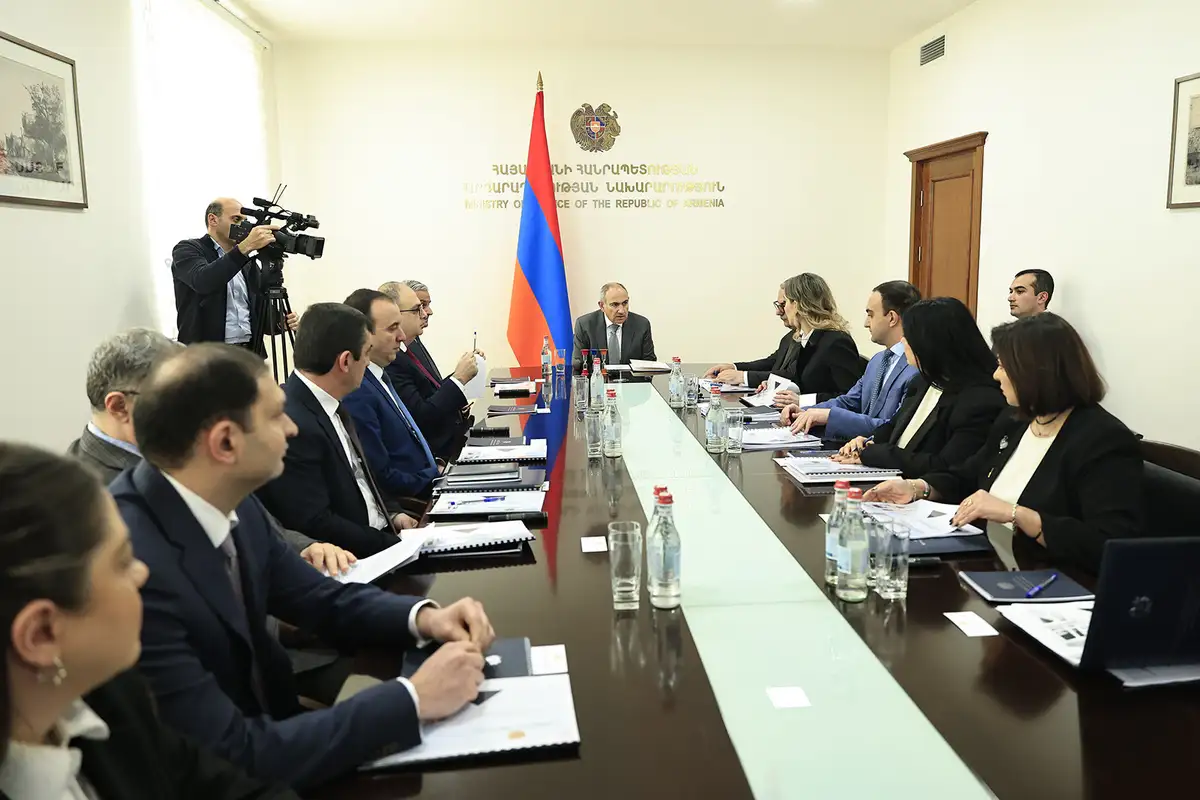


Prime Minister Nikol Pashinyan visited the Ministry of Justice, where the department's 2025 activity report was discussed.
Minister of Justice Srbuhi Galyan reported that the previous year's performance was 94.7%. During the reporting period, the electronic system for administrative proceedings was launched, and currently, 72% of cases are handled electronically. The modernized Arlis platform, integrated with e-Draft, enables joint use of the platforms—mandatory mediation in marital and family cases and e-mediation. The Am platform was also launched.
It was reported that, to enhance the effectiveness of rights protection and dispute resolution, it is proposed to set clear deadlines for the examination of civil and administrative cases, and drafts have been submitted to the National Assembly. A 6-month period is provided for the examination of civil cases, which may be extended twice by 3 months each, but the examination must not exceed 1 year. In administrative cases, 6 months is set; this can be extended twice by 6 months each, but the case must be examined within 1.5 years.
A legislative draft to limit appeals to administrative bodies has also been submitted to the National Assembly, aiming to reduce the courts' workload by 30%. The package of these drafts provides for limiting appeals from administrative bodies to the Court of Appeals to amounts not exceeding 300,000 drams. If the legislative package is adopted, the number of appeals submitted to the Court of Appeals is expected to decrease by 2,000.
Within the framework of the institutional reform of the State Register of Legal Entities, a new system has been launched that is interconnected with the SRC, BPR, and Depository systems, includes an improved Beneficial Owners System, and an automated tool for initiating proceedings. Although the system was launched in December 2025, 1274 individual entrepreneurs, one foundation, and 4 LLCs have already been registered. In other words, the new system enables quick, efficient online registration of all organizational and legal forms.
Referring to the digitalization process in this direction, the Prime Minister noted: "What should be our task in the direction of digitalization: to introduce the system, let it work for some time in parallel, let us make sure that this system provides what needs to be provided, and gradually complicate and limit the capabilities of the paper version, so that, in the end, it comes out."
The Head of State, speaking about applications and letters addressed to the state system, noted: "Practice shows that there are people who take the same letter to this Ministry, that Ministry, the National Assembly, the government, the presidential residence, the prosecutor's office, etc. Now we are introducing a principle of digitalization and saying that the state should ask the citizen one piece of information once, in the same way, the citizen should submit one question to the state in one place, electronically, because a huge amount of time and resources are spent on it."
In this regard, the responsible persons reported that the system is currently in development.
In the context of improving the integrity verification tools, mechanisms for the publicity of the final part of integrity conclusions, as well as the review of the integrity of persons holding public office (PTEF) with a wide range of powers and the authority to make independent decisions, have been established, the drafts of which have been submitted to the National Assembly.
The approved concept for introducing effective mechanisms in personal data protection envisions the creation of an Independent Autonomous Body.
The Prime Minister was informed that a package of projects has been submitted to the National Assembly, which resolves the problems accumulated over the years in the field of alienations carried out in the overriding public interest.
During 2025, the National Assembly adopted a package introducing a system for implementing electronic notifications. The cases in which electronic notifications are mandatory and properly implemented are defined.
Reforms have also been implemented in bankruptcy law. The Bankruptcy Code has been introduced, which envisages bankruptcy only based on an obligation that has been confirmed by a court order and has passed the stage of compulsory execution, provides for negative consequences for the debtor in the event of debt relief based on bankruptcy, and the property will be sold by electronic auction without the human factor.
As part of the judicial reforms and to ease the courts' workload, several procedural issues in administrative proceedings have been simplified, reducing the burden and ensuring the efficient, rapid examination of cases. A written procedure for examining cases has been introduced in the administrative and criminal courts of appeal, and a 6-month examination period has been established, which may be extended by up to 4 months.
It was reported that a package was circulated proposing to impose an administrative penalty, in the form of suspension or deprivation of the right to drive, for failure to comply with an administrative act. Criminal liability for the same acts will be strengthened, and administrative liability for driving a vehicle by persons without the right to drive will also be tightened.
Next, the system of conditional early release from serving a sentence and its improvements were discussed. Prime Minister Pashinyan emphasized the importance of this process and noted: "In our country, in fact, what has been the Practice in recent decades? We periodically resort to the institution of amnesty, which does not individualize, that is, does not evaluate a person, but rather evaluates the article de jure. Now we must follow a different logic and implement an individual assessment system, which is also important from the point of view of manageability and resocialization."
As part of the reforms, the minimum sale price for the debtor's only apartment has been set at 7,800,000 drams, effective January 1, up from 4,900,000 drams.
In 2025, the Armenian Center for Arbitration and Conciliation received more than 300 arbitration and more than 200 mediation cases.
The quality of services provided to citizens has also improved: in September 2025, the Ministry's hotline system was introduced, through which citizens have the opportunity to call and receive information on the Civil Registry, the Civil Registry, Administrative Procedure, the Registry, as well as other issues related to the Ministry's jurisdiction. Sixteen thousand one hundred ten calls were received, of which 8,289 were answered using an artificial intelligence system, thus reducing the number of physical responses by 49%.
It was reported that the Compulsory Enforcement Service confiscated more than 64 billion drams on behalf of claimants in 2025, 6 billion 252 million drams more than in 2024, representing 11 percent. Of the above confiscated funds, 20 billion 819 million drams were allocated to the state budget, 8 percent more than in 2024.
Civil Status Acts Registration Services have been digitized. It is already possible to use online services for the birth of a child, marriage, paternity recognition, and more. One hundred four marriages have been registered online in two months.
In the context of EU visa liberalization, 26 guidelines related to the Ministry's competence have been highlighted across 3 sectoral directions. A schedule for implementing the Ministry's actions has been developed.
This year, it is planned to present the text of the new Constitution, the Code of Administrative Offenses, and the unified electronic platform for judicial administration and case management. It is planned to introduce the electronic system of criminal proceedings, the electronic notary system, the electronic bankruptcy system, and the automation of judicial statistics. Deadlines for the examination of criminal cases will also be established, as will regulations governing the continuation of examination from the point of interruption in the event of a change of judge, and simplifying the process of examining evidence.