



From August to October 2025, global ocean surface temperatures remained above average. The North Pacific Ocean, in particular, warmed. Equatorial temperatures decreased slightly, but overall seasonal averages were within the range of zero deviation. Other regions also experienced slight declines in El Niño indices. Despite these various anomalies, weak La Niña-like interactions between the ocean and the atmosphere persisted, most notably through precipitation anomalies.
Forecasts indicate that sea surface temperature anomalies will weaken in the winter of 2025/2026, consistent with a weak La Niña. The western Pacific is expected to remain above average, maintaining the strong east-west thermal contrast and enhancing La Niña-like atmospheric processes in the equatorial zone.
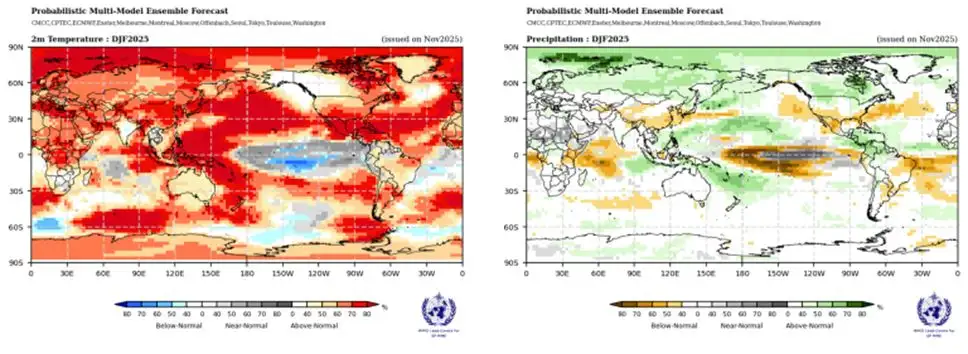
The IOC multi-model projections for the winter of 2025/2026 show a significant increase in the likelihood of above-average land surface temperatures worldwide. A high probability of above-average temperatures is projected for southern and northeastern North America, Central America, the Caribbean, and the Arctic regions. In the Southern Hemisphere, such conditions are most likely over New Zealand and southern South America, with a relatively small increase in this probability over Australia.
The 2025/2026 winter precipitation projections for the equatorial Pacific are also consistent with a weak La Niña. Increased precipitation is projected in northern North America, southern Central America, the Caribbean, northern Europe, and northern Asia above 50° north latitude.