
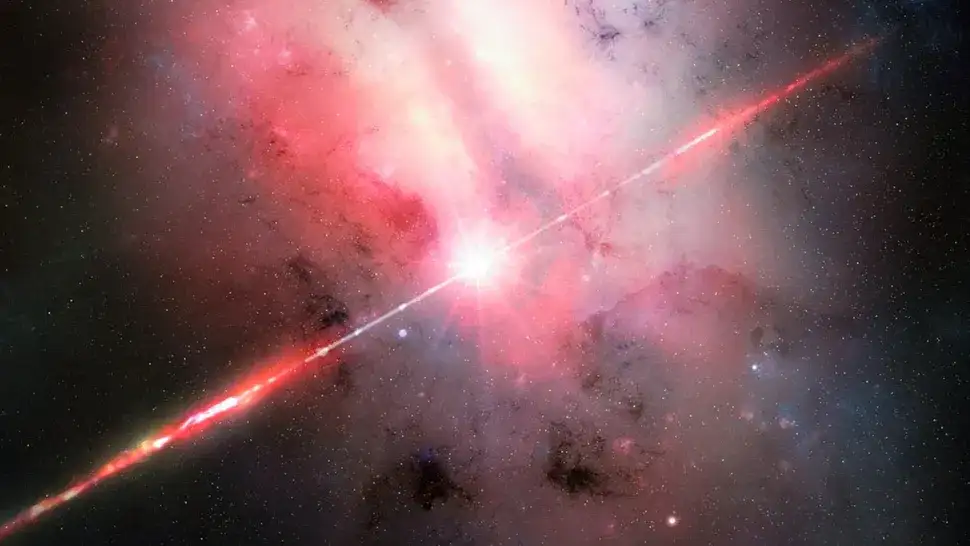


Astronomers have discovered the longest cosmic explosion, which lasted 7 hours and, according to scientists, could have been caused by a black hole destroying a star.
Such phenomena are considered the most powerful explosions in the universe since the Big Bang. NASA's Fermi telescope detected GRB 250702B on July 2, 2025, which immediately stood out among the roughly 15,000 explosions recorded to date. The explosion not only lasted a record 7 hours but also continued for several days, making it a unique opportunity for study.
Subsequent observations showed that it occurred in a galaxy billions of light-years away. Data from powerful telescopes indicate that the gamma rays were produced by a plasma jet traveling at nearly the speed of light that collided with its surroundings.
Scientists are considering three possible causes: a black hole colliding with a star that had lost its outer layers, a small body such as a dwarf star or planet falling into the black hole's intense gravity, or, most intriguingly, the destruction of a star by an intermediate-mass black hole. If the latter is true, it would be the first time such a black hole has been observed destroying a star.
After the Big Bang. NASA's Fermi telescope detected GRB 250702B on July 2, 2025, which immediately stood out among the approximately 15,000 explosions recorded to date. The explosion not only lasted a record-breaking seven hours, but also continued for several days, making it a unique opportunity for study.
Scientists are considering three possible causes: a black hole colliding with a star that had lost its outer layers, a small object such as a dwarf star or planet falling into the black hole's intense gravity, or, most intriguingly, the destruction of a star by an intermediate-mass black hole. If the latter is true, this would be the first time such a black hole has been observed destroying a star.