

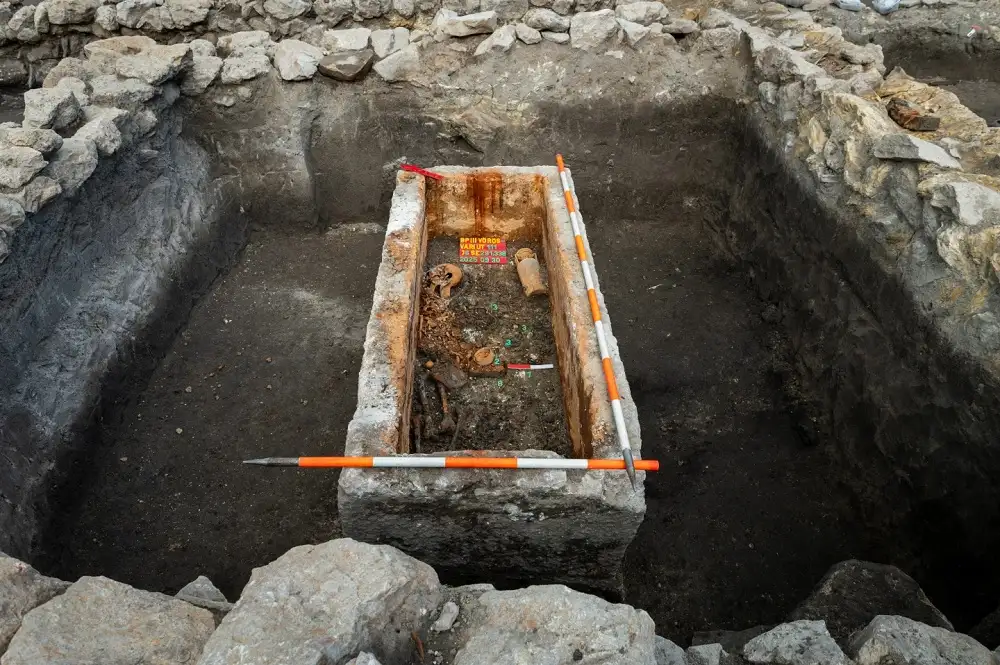


In the Óbuda district of the Hungarian capital Budapest, on the site of the former Roman city of Aquincum, archaeologists have discovered an exceptionally well-preserved limestone sarcophagus, in pristine condition.
The sarcophagus, which was sealed with metal clips and molten lead, has not been robbed for centuries. After opening the lid, the complete skeleton of a young woman was discovered, surrounded by dozens of objects:
- two complete glass vessels,
- bronze figurines,
- 140 coins,
- a bone hairpin,
- amber jewelry,
- traces of gold-thread clothing.
“This was a hermetically sealed sarcophagus that no one had opened before. It was completely intact,” said Gabriella Fenyes, head of the excavation.
The burial took place in an abandoned residential area in the 3rd century, which was later converted into a cemetery. A Roman aqueduct and eight simpler tombs have been found nearby, but none compare to the richness and preservation of this burial.
“The relatives buried the deceased very carefully. It is clear that they really loved the person buried here,” Fenyes said.
The sarcophagus was made especially for this woman. In the 4th century, old sarcophagi were often reused, but this one was new.
The find indicates that the young woman belonged to a high social class or came from a wealthy family.
A layer of silt about 4 cm thick was also removed from the inside of the sarcophagus, where archaeologists hope to find additional jewelry, including earrings, during the sifting.
Research will soon determine the woman’s age, health status, and origin.