
Politics
The Prime Minister emphasized the importance of women's involvement in the justice sector



Prime Minister Nikol Pashinyan participated in a panel discussion titled "Practical or Procedural Obstacles to Maintaining Reasonable Time Limits for Examining Judicial Cases" as part of the event dedicated to the Day of the Judiciary.
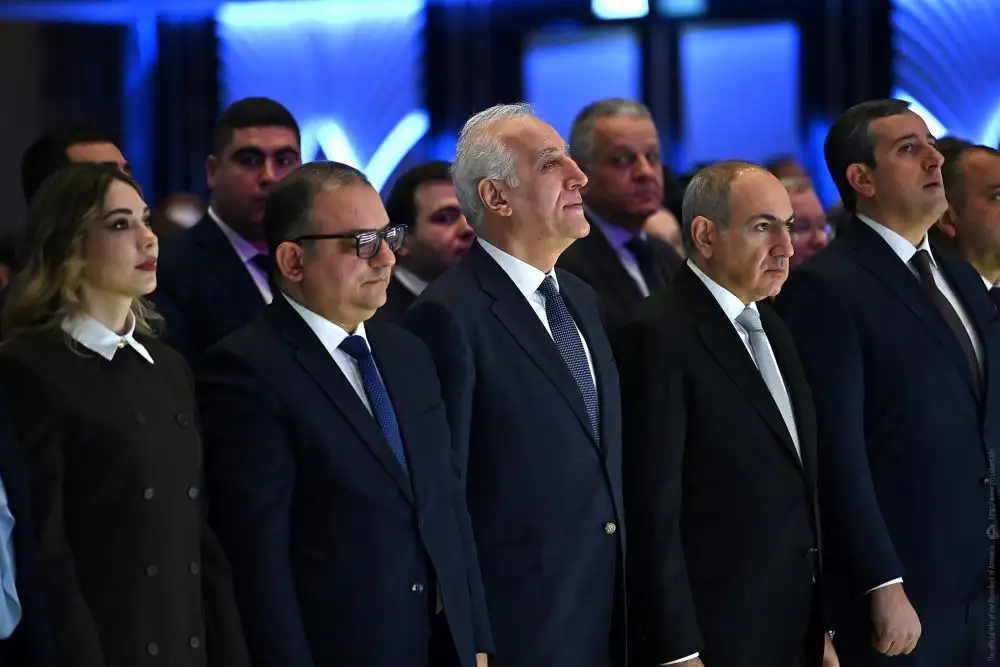
The event was also attended by President of the Republic Vahagn Khachaturyan, President of the Constitutional Court Arman Dilanyan, President of the Supreme Judicial Council Vahagn Atabekyan, Deputy Prime Minister Tigran Khachatryan, members of legislative and executive bodies, representatives of the judicial and legal sphere, and diplomats.
In addition to the Prime Minister, the panel discussion was attended by Chairman of the Supreme Judicial Council Vahagn Atabekyan, Chairman of the Standing Committee on State Legal Affairs of the National Assembly Vladimir Vardanyan, Minister of Justice Srbuhi Galyan, President of the Court of Cassation Lilit Tadevosyan, and Prosecutor General of the Republic of Armenia Anna Vardapetyan.
Nikol Pashinyan noted in his speech that, when addressing issues in justice and other spheres, it is necessary to delve deeper and examine the problem's conceptual foundations. The Prime Minister emphasized that, including in the justice sector, there is a need to clarify basic concepts, such as what justice and fairness are. "Everyone demands justice and fairness, but it is important to understand what our public perception of justice and fairness is, what problem we want to solve," the head of state said.
According to the Prime Minister, there are three sources of legitimacy in the Republic of Armenia: the people, the Constitution, and the legal system derived from the Constitution. "And if it turns out that there is a rupture between the people and the Constitution, doesn't it turn out that the legal system established in the Republic of Armenia has a legitimacy problem?"
Nikol Pashinyan noted that many issues in the field have been resolved, but new ones continue to arise and must be addressed. "My proposal is the following: the organic connection between the people and the legal system must be established. People must recognize the legitimacy of the rule of law. We have resolved the issue of the government's legitimacy; we have not resolved the issue of the rule of law's legitimacy. We resolved the issue of the government's legitimacy: the election results are not in doubt. But the election by which the rule of law was established, that is, the referendum, its results have always been in doubt and are still in doubt today. And until that doubt is eliminated, the legitimacy of the rule of law will destroy us like a virus. We will never achieve either fairness or justice, because, after all, it is first and foremost a feeling," said Nikol Pashinyan, expressing conviction that the majority in Armenia does not have that feeling, the reason for which is that there is a problem of the legitimacy of the rule of law in Armenia.
Stressing the importance of holding discussions in this format, the Prime Minister noted that this public conversation on existing issues and problems must take place, as they must be faced and resolved.
Nikol Pashinyan also noted that, while about 70 percent of the applications and letters he previously received were related to the judicial system, he now receives very few letters on the subject.
In identifying ways to resolve existing issues in the sector, the Prime Minister emphasized the need to address them at their root causes. "We need to address the answers to the questions we know, because the answer that was correct 5 or 10 years ago is not necessarily complete today. Addressing the obvious, I think, is a component of development," the head of state emphasized.
Nikol Pashinyan also emphasized the importance of women's participation in the justice sector and noted that their representation in the industry has increased.
In summary, Prime Minister Pashinyan noted: "What is justice, what is fairness, what does a judge's conscience mean, what does an independent judicial system mean, regardless of who? Who bears responsibility for justice and the quality of justice in the country? How does that responsibility bear? These questions are primarily conceptual, but I consider it important that any practical reality aligns with conceptual frameworks, because what we do is very important. In many cases, we take irregular actions because the conceptual basis is missing."