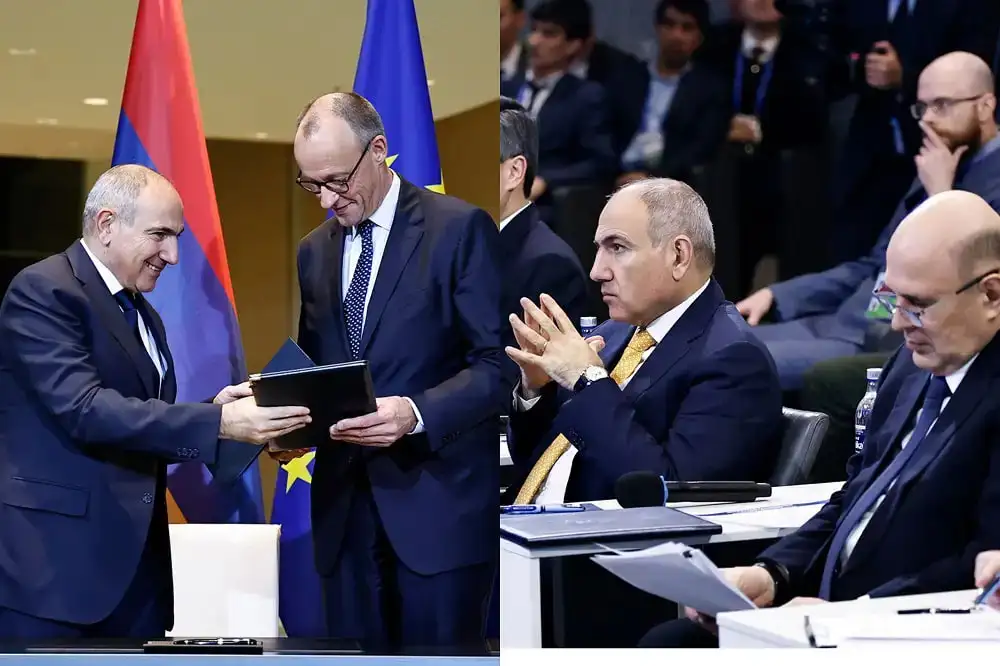

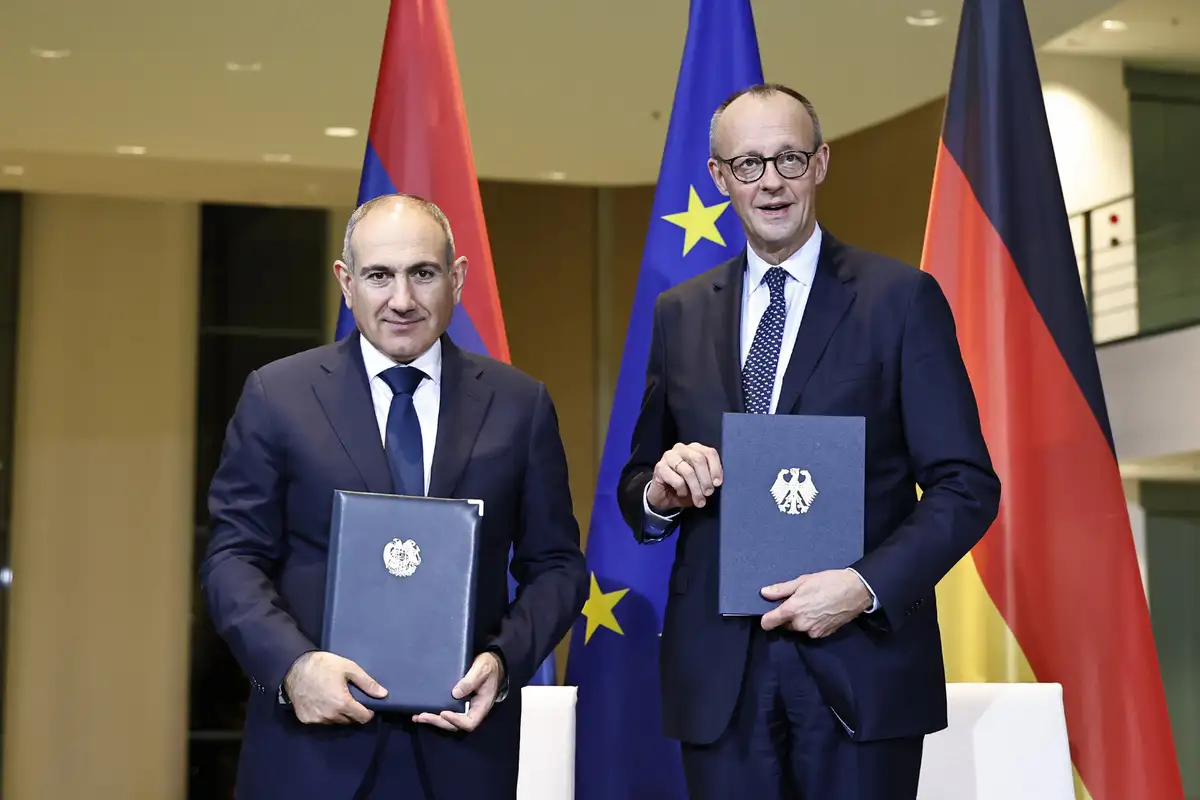


Following the meeting, Prime Minister of the Republic of Armenia Nikol Pashinyan and Federal Chancellor of the Federal Republic of Germany Friedrich Merz signed a joint declaration on the strategic agenda of the bilateral partnership between the Republic of Armenia and the Federal Republic of Germany.
The Declaration, in particular, states:
“The Federal Republic of Germany and the Republic of Armenia (hereinafter referred to as the Parties) recognize the long-standing and friendly relations established between the Parties. They confirm their mutual desire to deepen bilateral partnership and cooperation, as well as their trust in each other and the convergence of interests across various fields. Recalling their mutual commitment to protect and promote freedom of expression, democracy, human rights, the rule of law and a rules-based international order, including respect for the sovereignty, independence and territorial integrity of each state, the Parties reaffirm their joint commitment to the purposes and principles of the Charter of the United Nations, the Helsinki Final Act and other international legal instruments promoting peace and security.
The Parties recall the framework established by the EU-RA Comprehensive and Enhanced Partnership Agreement (“CEPA”), as well as the priorities set out in the Strategic Agenda for the RA-EU Partnership. They note with satisfaction the Republic of Armenia’s aspiration to further strengthen its ties with the European Union and the broader community of democratic states, as well as the importance of the established formats and initiatives for bilateral political dialogue, development cooperation, security assistance, joint efforts to combat cyber threats and disinformation, and economic, cultural, and scientific cooperation.
The Parties share the positive assessment of the initialling of the Agreement “On the Establishment of Peace and Interstate Relations between the Republic of Armenia and the Republic of Azerbaijan” and welcome the recent developments in the normalisation of bilateral relations between Armenia and Azerbaijan. The Parties agree that the full normalisation of relations, including those between Armenia and Turkey, creates opportunities for a peaceful and prosperous South Caucasus region.
The Parties have reached the following understanding:
1. The Parties intend to cooperate in the following areas, but are not limited to:
a. Political and diplomatic cooperation: regular consultations between ministries, agencies, and diplomatic missions, high-level visits, and thematic dialogues.
b. Economic and trade cooperation: promotion of bilateral trade and investment opportunities, cooperation in the field of biodiversity, including in the context of the COP17 to be held in Yerevan, in the fields of energy, connectivity and infrastructure, technology and transport, as well as tourism development.
c. Development and capacity building: continued cooperation, including through technical and financial assistance programmes and training initiatives, in areas such as sustainable economic development, vocational training, renewable energy and energy efficiency, climate and environmental protection, biodiversity and nature conservation, water resources management, good governance and municipal development, justice and constitutional reform, promotion of the rule of law, joint projects aimed at socio-economic development.
d. Culture, education, language, and people-to-people exchanges: academic partnerships and research cooperation, scholarships, sister cities, cultural exchange events and programmes that promote mutual understanding, including in the field of youth and sport.
e. Science, technology, and innovation: joint research projects, cooperation in the field of digital transformation, emerging technologies, and innovation ecosystems.
f. Security and defence: dialogue on regional and global security issues, including nuclear security, cybersecurity, countering disinformation, cooperation on security sector reform and actions related to the UN resolution on women, peace and security, and exchange of information and best practices in areas of mutual interest.
2. This Declaration is not an international treaty and therefore does not create rights or obligations under domestic or international law. Implementation of actions under this Declaration will be subject to the availability of resources and the relevant laws and regulations of the Parties. The Parties may define and mutually determine additional areas of cooperation. This Joint Declaration may be amended at any time by mutual written consent of both Parties. Either Party may terminate the cooperation envisaged by this Joint Declaration at any time. It shall notify the other Party in writing of its intention to terminate the collaboration at least six months in advance.