
Opinion
Pashinyan's Berlin-Moscow "tour": or the European equation with Eurasian unknowns
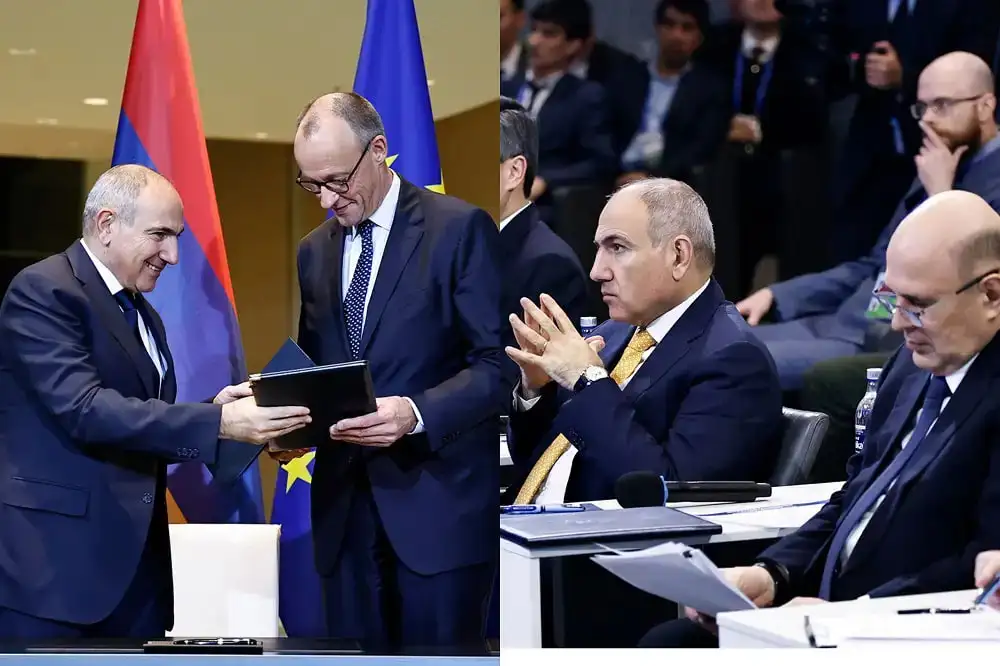


On December 2, Armenia and the European Union signed a strategic partnership agenda in Brussels. It serves to supplement and update the existing CEPA agreement between Armenia and the EU, as well as to symbolize the reality of raising Yerevan-Brussels relations to a strategic level.
A week later, on December 9, Armenian Prime Minister Nikol Pashinyan paid an official visit to Germany and met with the country's president and federal chancellor. As a result of the visit, a strategic partnership declaration between Armenia and Germany was signed.
On December 11, Pashinyan was already in Moscow and participated in the regular session of the Eurasian Intergovernmental Council. Participation in the EAEU session, against the backdrop of the European "tour" and the Brussels-Berlin-Moscow "route," reflected the logic of Yerevan's foreign policy, which creates misperceptions across capitals. It is noteworthy in several respects.
Shades of two-level integration
First, it is reiterated that deepening European integration is a priority for Yerevan. Armenia is seeking to strengthen its relations with the EU on two fronts. The first is the general, conceptual level, directly with Brussels, within which the signed strategic agenda is highly comprehensive. It covers areas including strengthening democratic institutions, security, economic diversification, visa liberalization, and resilience. It also outlines the prospect of providing Armenia with 250 million euros in assistance, subject to Yerevan's obligations.
The second level is the deepening of individual relations with EU member states. Before Germany, Armenia also signed a declaration of cooperation with the Netherlands with similar content. Yerevan will try to expand the list of these countries. This is not an end in itself; in the context of complex, convoluted, and sometimes bureaucratized decision-making mechanisms within the EU, which are delayed due to the conflict of political interests, the policy of building strategic relations individually aims to create strong footholds in the EU, especially in the most influential capitals for the EU.
The declaration signed with Germany is vital in the areas it covers: political dialogue, economy, infrastructure, innovation, education, security, and the fight against cyber threats. However, unlike the strategic agenda signed with the EU, it is a more declaratory document, does not create legal obligations, and depends on the parties' resources and political will. It sets out the agenda of the EU-Armenia strategic partnership in the Yerevan-Berlin format and supports it.
EU non-membership with the cost of membership
In the documents signed in Brussels and Berlin, there is no mention of a clear prospect of EU membership; they focus on deepening and expanding relations. This is a bilateral conscious approach. Neither Yerevan nor Brussels is ready for it. The EU is unable to extricate itself from the complex geopolitical situation created by the war in Ukraine. It has significant problems in resisting the alienation of an ally like the US, as well as the oppressive economic influence of the US and China. Brussels, under these conditions, cannot take on a new burden that would create a new front for potential confrontation with Russia. Armenia, in turn, is not ready for this, both because of infrastructural and systemic inconsistencies with EU standards and because of its unpreparedness for the economic consequences of Russia's expected intolerance. This situation allows Armenia to maneuver in the EU-EAEU space. In Brussels, in fact, they are not against it and are understandingly approaching Armenia's EAEU membership. The failed Ukrainian experiment with the two-way-street policy has sobered Brussels.
Unlike the EU, Russia is adopting a tougher rhetoric. And the stronger its positions in Ukraine, the stronger this rhetoric will become. This was hinted at during his stay in Moscow by Russian Deputy Prime Minister Alexei Overchuk, who reiterated in a direct statement that Armenia will have to choose between the EU and the EAEU at some point. However, as long as Yerevan's relations with the EU have not reached the point of irreversible integration, and the Ukrainian crisis is not fully resolved, Moscow is also avoiding putting the issue bluntly, unable to ignore the tangible US presence in the South Caucasus through TRIPP.
Reviving the ruins of the "Eastern Partnership."
Third, the EU is clearly reconsidering its policy in the post-Soviet space. An individual, targeted policy is replacing the former collective approach of the Eastern Partnership. Belarus, a member of the EaP program, has effectively been excluded from the game. Azerbaijan is politically alienating itself while culturally orienting itself towards the Turkic and Central Asian environment. The EU is closing its doors to Georgia due to its deviation from the European course. In these conditions, only Moldova and Armenia view European integration not only as a value, but also as an instrument of state security and sovereignty. The issue is not the EU assuming direct responsibility for Armenia's security; the EU does not have that capacity today: its member states need to rebuild their security systems without the US umbrella. But through its tools, such as the continuation of the EU observation mission to monitor the Armenia-Azerbaijan border, the provision of non-lethal weapons to the Republic of Armenia's defense and security system, and the development of the armed forces' capabilities, the EU has a tangible impact. In this sense, Germany, given its technological development, can serve as a strategic partner for Armenia within the European Union.
While waiting for the end of the post-Soviet era...
Fourth, by leaving Germany for Moscow immediately, Pashinyan is trying to show the relative ease of his decisions. He also indirectly emphasizes that Armenia does not face the problem or goal of choosing between economic and political blocs. Yerevan understands that, as long as the industry and services sectors and the state administration system are not ready for European markets and standards, withdrawal from the EAEU could deal a severe blow to the economy, with all the consequences that follow. However, Yerevan openly states that it has already made its civilizational choice. Its symbolic expression was Pashinyan's statement in Germany that the era of the Soviet political legacy and post-Sovietism is over. In reality, it is not over yet: the outcome is being decided on the Ukrainian fronts. However, the complementarity policy chosen by Yerevan is intended to make the transition from that era smoother. This is evidenced by simple economic and statistical calculations: in 2024-2025, trade turnover with the EAEU will decline, while turnover with EU member states will increase significantly.
Gor Abrahamyan